

Read the October 20th, 2026 Green Bay Innovation Group Newsletter here.
Read the October 20th, 2026 Green Bay Innovation Group Newsletter here.
Get links to the latest news, events, stories, and interviews from our 5P news members. Our goal is to remind the decision-makers in Wisconsin of the importance of our industry both historically, and more importantly, into the future.
Read the latest 96 Stories and Links on the Internet below.

Green Bay Innovation Group invites you to Shaping the Future of Food Packaging on Oct. 28 at the Alliant Energy Center in Madison. This in-person seminar is devoted to food packaging technology, sustainability, and market trends. Industry experts will give real-world examples of smart packaging innovations, opportunities, and challenges facing the food packaging industry.
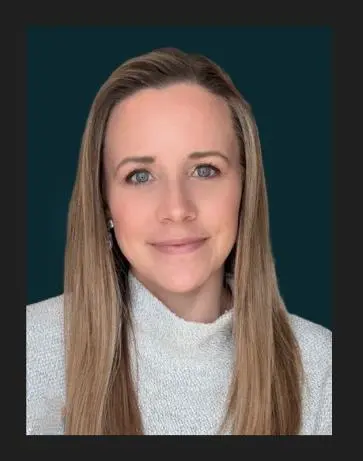
Rebecca Higgins is a nationally recognized PFAS leader with more than 28 years of experience in environmental regulation, hydrogeology, remediation, and strategic advisory services. As PFAS Remediation Leader at AECOM, she advises public and private sector clients on complex PFAS challenges.

Ben Weight is a Senior Director of Asset Management at Amcor. He leads initiatives focused on maximizing investment performance, enhancing operational efficiency, and driving long-term portfolio growth. Throughout his career, he has partnered with executive leadership, investment teams, and operating partners to improve portfolio performance and execute strategic business initiatives.

Mike Van Sickle is a marketing and product management professional with a strong background in sustainable packaging solutions, product innovation, and cross functional leadership. As Senior Marketing Manager at Amcor, Mike leads strategic marketing initiatives focused on driving growth. Throughout his career, he has successfully guided product launches, managed complex cross-functional programs, and translated market trends into commercial successes.

John Wilson is Director of Marketing for Rapids Paper + Packaging, a division of Little Rapids Corporation, where he leads marketing strategy, brand development, and commercialization support for the company’s specialty paper and flexible packaging businesses. John plays a key role in advancing ECOVA®, the company’s platform of heat-sealable and functional barrier paper packaging solutions.

Kevin Meyer is the National Account Manager – Custom at Bardes Plastics, bringing extensive expertise in custom thermoformed packaging solutions, strategic account management, and manufacturing innovation. With a proven track record of building high-value partnerships across industries, Kevin works closely with clients to guide complex packaging projects seamlessly from initial design to final production, with a strong focus on sustainable solutions like recycled polyethylene terephthalate (RPET).

Mark Hunter has over 25 years of pulp and paper experience as an Asset Manager, Production Manager, and Process Engineering/Technical Superintendent. Currently, Mark is the Value Stream Manager and Director Technology Innovation at Hoffmaster Group Inc. Mark leads a team of 32 maintenance and engineering employees at Hoffmaster Group Inc., a leading printed napkin and paper plate plant with 420 employees.
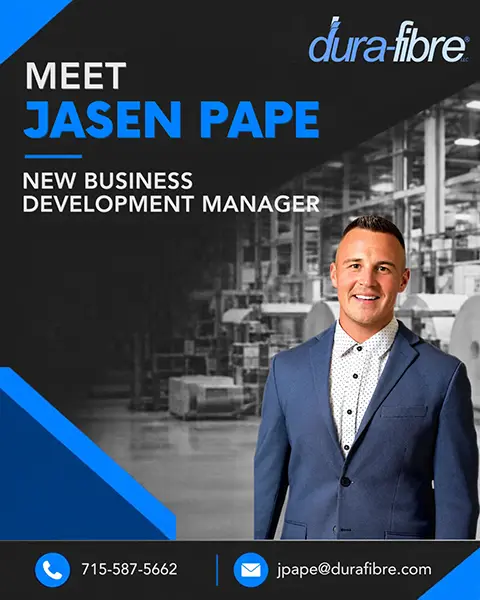
Please join us in welcoming Jasen Pape as Dura-Fibre’s new Business Development Manager. Jasen brings a strong background in sales, account development, and manufacturing, most recently serving as a National Account Executive with F.C. Dadson and previously holding progressive leadership roles with Muza Metal Products for more than 13 years.
As Dura-Fibre continues to invest in growth, expand our presence nationwide, and support the increasing demand for quality paperboard solutions, Jasen’s experience in developing new business and building strong customer relationships will be a valuable asset. We have the capacity, capabilities, and commitment to grow with new and existing customers across the country, and Jasen will play a key role in helping drive that growth.
We are excited to have Jasen on board and look forward to the impact he will make as we continue to strengthen partnerships and expand Dura-Fibre’s reach in the marketplace.

QuiCK Transport is a family-owned transportation company built on safety, reliability, and strong relationships. We specialize in flatbed and open-deck transportation, helping businesses move freight across the United States and Canada.
From standard shipments to oversized loads and specialized transportation needs, our team works to find solutions that keep our customers moving.
We believe transportation is about more than moving freight from one place to another. It’s about earning trust, communicating clearly, and doing the job right. Our team takes pride in providing dependable service and finding solutions for the unique challenges our customers face. We’re a one-stop shop for reliable flatbed trucking services, logistics and specialty warehousing.
Behind every shipment is a team of drivers and transportation professionals who keep businesses moving. We’re proud of the people who represent QuiCK Transport and the relationships we build with the customers and communities we serve.
Contact Us:
920-759-0618
Dispatch@qcktrans.com
1900 Tower Drive, Kaukauna, WI 54130
Oct 14, 2026 · @Doug Barton
In June, 698 people filled Lambeau Field for the first Wisconsin Drives Manufacturing Summit. The Fox Valley sent 240 of them, the largest group in the room. On October 6, the network took its first step toward a year-round presence: a WDM regional event hosted inside the UWEBC Annual Conference at Monona Terrace in Madison.
WDM×Madison was a new manufacturing track built for the same purpose the Summit served. It connected manufacturers with expertise from Wisconsin’s universities, technical colleges, and industry partners. Scott Manley of Wisconsin Manufacturers & Commerce opened with the case for manufacturing’s importance to Wisconsin’s economy and communities. What followed was a day of practical sessions on workforce, technology, and strategy — and a working model that GBIG and other regional groups can bring into their own events.
Oliver Schmitz, UW–Madison’s Associate Dean for Corporate Engagement and Entrepreneurship, used the stage to lay out what Wisconsin Drives Manufacturing is and where it is going. His starting point was simple: the challenges Wisconsin manufacturers share — workforce shortages, technology adoption, supply chain resilience, and emerging markets — can’t be solved by any one company or institution alone. WDM exists so manufacturers can connect, collaborate, innovate, and compete with the whole state behind them.
He described WDM as Wisconsin’s statewide manufacturing network: more than 100 engaged stakeholders — manufacturers, researchers, educators, policy-makers, economic developers, and technology leaders — coordinated by the College of Engineering at UW–Madison. GBIG is one of them, alongside the NEW Manufacturing Alliance, UW–Green Bay’s Resch School of Engineering, and TitletownTech. The work is organized around four pillars: Workforce, Technology, American Made, and New Markets.
The June Summit proved the demand. Oliver’s numbers: 698 participants from 336 organizations, 64 percent of them from industry, and 18 opportunities for action identified in the room. Then his central idea — WDM is moving from one summit to a year-round network, and it comes to you. WDM×Madison is the pilot of a model for independently organized regional WDM events. The partnership network, with its universities, technical colleges, and industry partners, shows up at your regional event. The aim is to move manufacturing innovation from discussion to implementation.
Preparing people for what comes next was the morning’s central theme, and it will sound familiar to anyone running a mill, a converting line, or a packaging plant in Northeast Wisconsin. Madison College’s Grant Emmel and Matthew Garcia showed how academic programs and customized employer training develop tomorrow’s technicians while strengthening the workforce already on the floor. Their message: build capability before workforce needs become shortages. The same model lives in every technical college district in the state.
UW–Madison’s Lennon Rodgers continued that conversation through hands-on engineering education, industry-sponsored capstone projects, and new CNC machining, casting, and forging programs at the Grainger Engineering Design Innovation Lab. Both sessions gave manufacturers practical ways to engage — from developing their own employees to bringing a real business challenge into a student project.
The afternoon pushed the room to think differently. Aurora WDC’s Arik Johnson demonstrated a new interactive scenario-analysis tool that combines AI with human expertise. Drawing on Clayton Christensen’s work on innovation, he explored how established companies get comfortable with what made them successful — a risk any mature industry knows well. The audience jointly chose a future scenario, and the tool developed strategic questions and possible positions for a UWEBC member company in that space. Arik described it as delivering roughly 60 percent of his earlier wargame simulation’s capability for “10 cents on the dollar.”
Joe Hamann of UW–Milwaukee’s Connected Systems Institute showed how manufacturers can test connected systems and AI before making larger investments, and develop the skills to run them at the same time. His theme — test before you invest — is a practical answer for plants weighing automation and Industry 4.0 choices without disrupting production.
Chris Baichoo of WMEP Manufacturing Solutions brought the day’s conversations together: start with the business problem, understand its root cause, and connect with the capabilities needed to solve it. A WMEP–UW–Milwaukee collaboration to improve Lean assessments showed that approach in action. For small and mid-sized manufacturers without a deep bench, Wisconsin’s MEP network is the front door to the rest of the system.
Chelsy Cegielski, UW–Madison’s InterPro Engagement Manager, closed the track by pointing to opportunities to work together on professional development and workforce needs, and inviting manufacturers to continue the conversation.
What stood out to me was how naturally the conversations connected. Each organization brought different capabilities and showed how partnership makes them more valuable. That is what we wanted manufacturers to see: people they can call, resources they can use, and partners who can help them think through a challenge or explore a possibility.
The Summit started in Green Bay, and the Fox Valley showed up in greater numbers than any other region. WDM×Madison proved the stage can travel. The paper, packaging, printing, plastics, and converting companies that make Northeast Wisconsin what it is face the same workforce, technology, and market questions that filled the room in Madison, and they have partners within driving distance — UW–Green Bay, NWTC, the NEW Manufacturing Alliance, and the MOC/MEP network — ready to answer them.
Stay in the loop or learn more at widrivesmanufacturing.com or www.uwebc.wisc.edu.
|
Speaker |
Title and organization |
Session |
|---|---|---|
|
Practice Director in Residence – |
Welcome: WDM×Madison 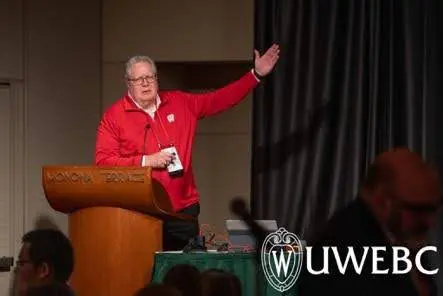 |
|
|
InterPro Engagement Manager, UW–Madison |
Welcome and closing 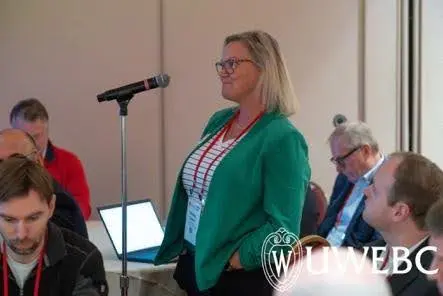 |
|
|
Associate Dean for Corporate Engagement and |
Welcome; The 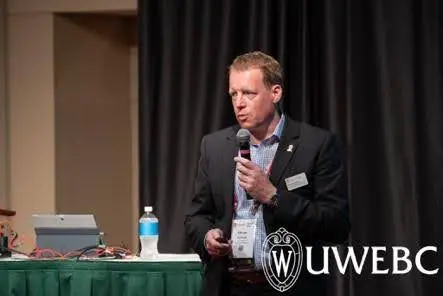 |
|
|
Executive Vice President of |
The State of Manufacturing 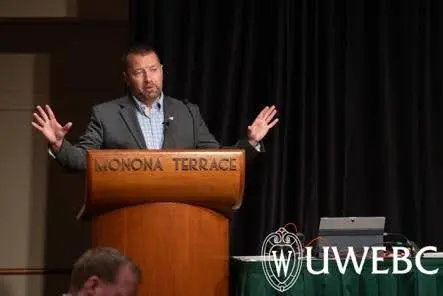 |
|
|
Electronics Technology and Electrical Engineering Technology Faculty, Madison College Account Executive, Business and Industry Customized Services, Madison College |
Building the Technical Workforce for What’s Next 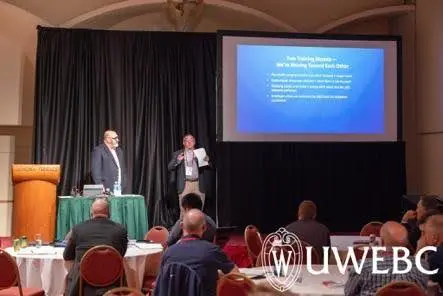 |
|
|
Director, Grainger Engineering Design Innovation Lab, UW–Madison |
Where Engineering Meets 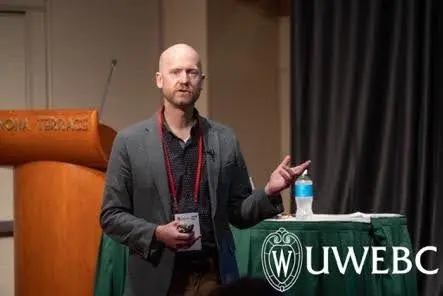 |
|
|
Founder and Chairman, Aurora WDC |
Finding the Strategic Choices Your Competitors Can’t See 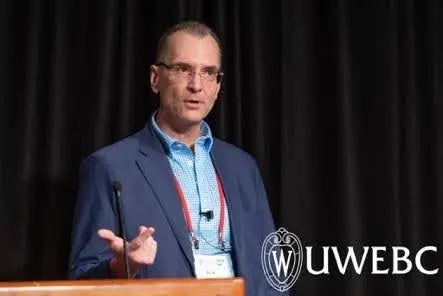 |
|
|
Executive Director, Connected Systems Institute, UW–Milwaukee |
Test Before You Invest 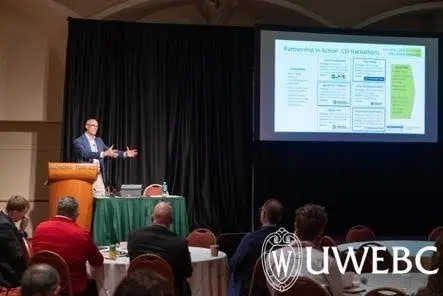 |
|
|
CEO and Executive Director, WMEP Manufacturing Solutions |
Wisconsin’s Manufacturing Extension Partners: Connecting the Pieces 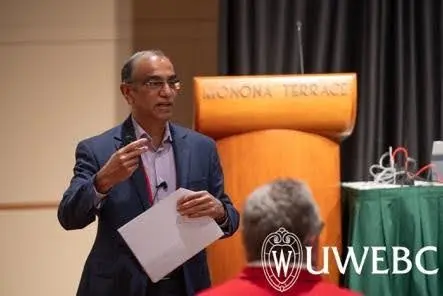 |
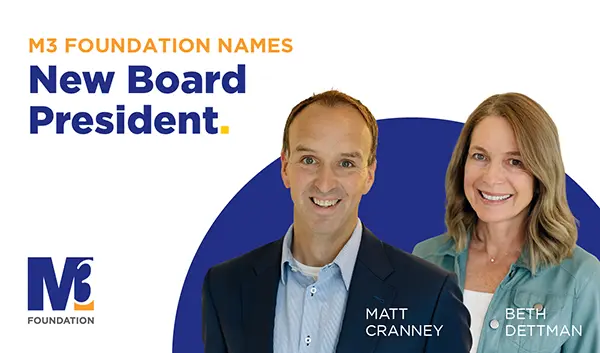
MADISON, WI — The M3 Foundation today announced a leadership transition on its board, recognizing Beth Dettman for six years of dedicated service and leadership as board president and welcoming Matt Cranney as the Foundation’s new board president.
Beth Dettman’s tenure marked a period of significant growth and expanded impact for the Foundation. When she assumed the role of board president in 2020, the Foundation awarded 55 grants annually, with M3 serving as its primary funding source. Under her leadership, the Foundation broadened its reach by creating new opportunities for individuals and organizations to contribute while expanding grant-making efforts to nonprofit organizations across Wisconsin, Illinois, Michigan, and Minnesota.
Today, the M3 Foundation awards more than 100 grants annually throughout M3’s footprint. The Foundation’s growth has been fueled by increased engagement from M3 employees and supporters who have embraced the mission and helped expand its impact across the communities M3 serves.
“Beth’s leadership has been instrumental in shaping the M3 Foundation into the thriving organization it is today,” said Sean LaBorde, president and partner at M3. “Her vision helped expand both our reach and our impact, allowing us to support more nonprofit organizations and engage more people in our mission. We are grateful for her dedication, service, and the lasting legacy she leaves for the Foundation.”
As the Foundation looks ahead, Matt Cranney will lead its next chapter of growth and service.
“We are excited to welcome Matt as the next president of the M3 Foundation Board,” said Sean LaBorde. “Matt brings tremendous passion for our mission, through his thoughtful leadership approach and dedication to the communities where M3ers live and work. I am confident he will guide the Foundation as we continue to expand our reach and create meaningful opportunities for the nonprofits we support.”
The M3 Foundation and M3 extend their sincere gratitude to Beth Dettman for her years of service and leadership and congratulate Matt Cranney as he steps into his new role.
The M3 Foundation is a 501(c)(3) charitable organization dedicated to strengthening the communities where M3ers live and work. Through strategic philanthropy, the Foundation expands the impact of giving by supporting nonprofit organizations that create meaningful and measurable change. Governed by a board of M3 employees representing diverse roles and locations across the company, the Foundation reviews dozens of funding requests annually and invests in long-term community impact through multi-year grant commitments. The M3 Foundation focuses its giving on initiatives that advance financial education and literacy, healthcare and healthcare improvement, promotion of insurance careers, and safety improvement and disaster relief.

As manufacturers across Northeast Wisconsin continue looking for ways to improve efficiency, reduce lead times, and accelerate product development, 3D printing has evolved from a prototyping tool into a valuable production resource. The success of any 3D printing application, however, starts with one critical factor: material quality.
At COEX 3D, we are proud to manufacture engineering-grade 3D printing materials right here in Green Bay, Wisconsin. Using high-quality virgin resins, advanced extrusion technology, and strict quality control processes, our mission is simple: provide industrial users with reliable materials they can trust for functional, repeatable results.
Unlike many imported filaments that prioritize low cost over consistency, COEX 3D focuses on performance. Every spool is manufactured with tight dimensional control, monitored with laser measurement systems, and produced from carefully selected materials designed to meet the demands of engineers, manufacturers, and product developers.
When your production schedule is on the line, waiting weeks for materials is not an option.
Because COEX 3D manufactures filament in Green Bay, local businesses benefit from faster access to materials, responsive technical support, and direct collaboration with a team that understands the needs of Wisconsin manufacturers. Whether you’re developing prototypes, creating assembly fixtures, printing replacement parts, or supporting low-volume production runs, having a local material partner can significantly shorten development cycles and reduce risk.
Our team regularly works with manufacturers throughout the Midwest to identify the best material solution for specific applications, helping customers move from concept to production quickly and confidently.
One engineering material seeing increasing demand is ESD-safe PETG.
Electrostatic discharge (ESD) may be invisible, but it can create significant problems in environments where sensitive electronics are handled. A small static discharge can damage circuit boards, sensors, semiconductors, communication devices, and other electronic components before a product ever reaches the end user.
Many companies are already familiar with ESD-safe workstations and flooring. However, they often overlook the fixtures, trays, housings, and tooling being produced with standard plastic materials. Traditional 3D printing plastics act as electrical insulators, allowing static charges to build up and potentially discharge into sensitive components.
COEX 3D’s ESD-safe PETG was developed specifically to address this challenge. Manufactured in Green Bay using premium virgin resins, the material provides static-dissipative properties while maintaining the ease of printing, toughness, and chemical resistance that have made PETG one of the most popular engineering materials in additive manufacturing.
For companies involved in electronics manufacturing, automation, controls, robotics, telecommunications, or medical device production, ESD-safe materials can help reduce failures, improve product reliability, and support quality control initiatives.
COEX 3D offers much more than materials. Our team supports businesses with rapid prototyping, additive manufacturing consultation, custom material development, and production printing services. Whether you’re evaluating your first 3D printing project or looking to improve an existing process, we can help determine the best material and manufacturing approach for your application.
Northeast Wisconsin has a long history of manufacturing excellence. As a Green Bay-based company, COEX 3D is committed to supporting local businesses with high-performance materials, responsive technical support, and innovative additive manufacturing solutions.
If your organization is exploring ways to improve product development, reduce tooling costs, create custom fixtures, or protect sensitive electronic components with ESD-safe materials, we’d welcome the opportunity to help.
Engineering-grade filament. Local expertise. Made in Green Bay.
Contact COEX 3D today to learn how our American-made materials, including ESD-safe PETG, can support your next manufacturing project.

NEENAH, Wis. (October 2, 2026) – Menasha Corporation announced today that it ranked No. 17 on Deloitte’s Wisconsin 75™ list, a ranking of the 75 largest private companies in Wisconsin, based on sales revenue.
“We’re honored to be recognized on this list. This ranking reflects the hard work and commitment employees bring to Menasha Corporation every day. This recognition underscores the strength of our businesses and the commitment we share to delivering value for our customers,” said Chris Drees, President and CEO.
“The organizations recognized in the Wisconsin 75 exemplify resilience, vision, and a deep commitment to Wisconsin’s future. Their success stories inspire us all, and we are proud to honor their role in shaping our state’s economic landscape.” – P.J. DiStefano, Wisconsin managing partner of Deloitte LLP.
Deloitte’s annual Wisconsin 75 list salutes the largest privately held Wisconsin-based companies. These companies play a key role in the state’s economy. The Wisconsin 75 list is selected based on annual sales revenue.
To be eligible for Deloitte’s Wisconsin 75 recognition, companies must have a majority ownership (50+ percent) by an individual, individuals, family, employee stock ownership plan (ESOP), or private equity firm. Public companies (i.e., a company whose voting stock is listed on any exchange or actively traded over the counter) are eligible when greater than 50 percent of the value or vote of the shares are owned by individuals, family, ESOP, or private equity. Additionally, companies must have annual sales revenue of at least USD $50 million. The Wisconsin 75 excludes cooperatives and accounting, tax, legal, and consulting service companies.
Menasha Corporation is a leading corrugated and plastic packaging manufacturer and supply chain solutions provider comprised of two companies, Menasha Packaging Company and ORBIS Corporation. Menasha Corporation’s products and services are used by major food, beverage, consumer products, healthcare, pharmaceutical, heavy equipment, agriculture, industrial, and automotive companies. Established in 1849, Menasha Corporation is one of America’s oldest privately held, family-owned manufacturing companies. Headquartered in Neenah, Wisconsin, the company employs more than 7,800 employees in 100+ facilities in North America and Europe. For more information, visit menashacorporation.com.
Deloitte refers to one or more of Deloitte Touche Tohmatsu Limited, a UK private company limited by guarantee (“DTTL”), its network of member firms, and their related entities. DTTL and each of its member firms are legally separate and independent entities. DTTL (also referred to as “Deloitte Global”) does not provide services to clients. In the United States, Deloitte refers to one or more of the US member firms of DTTL, their related entities that operate using the “Deloitte” name in the United States, and their respective affiliates. Certain services may not be available to attest clients under the rules and regulations of public accounting. Please see www.deloitte.com/about to learn more about our global network of member firms.
By: Karter Underwood, Regional Sales Manager at QComp Technologies
The average consumer doesn’t give a second thought to how everyday consumer goods are packaged, especially simple boxes or sealed bags. Manufacturers of those goods, however, know that some products require rather complex packaging that, until recently, required assembly workers. One such example is nonwoven wet wipes
packaged in a plastic bag with a flip-lid dispenser.
With a forecasted growth of 6.2% compound annual growth rate (CAGR), the wet wipe market is expected to be valued at more than $30 billion by 2029. To keep up with that growth requires advanced automation.
While the packaging for nonwoven wet wipes isn’t complex, the assembly and robotics material handling process is. There are multiple steps to applying lids onto plastic wet wipe containers. Those individual steps are relatively simple, but putting all the pieces together within the desired tolerances and throughput rate is a major challenge.
Separate automation technologies must be perfectly aligned to perform multiple functions. For example:
There are so many small details and nuances within each of these steps. Achieving all these functions with precision requires more than a capable robot; it requires expert engineering and programming skills. Programmers will perform custom coding using a programmable logic controller (PLC) that Interacts with the robot and other connected equipment. PLC is the brains of industrial machinery, controlling the conveyors, start/stop functions, buttons, photo eyes, and everything else interacting with it.
Tracking product locations in real-time to ensure correct placement is also complex. The programming must ensure:
Solving the challenge of automating the wet wipe lidding process is all about the interaction between the robot and the PLC and getting all the communication and high-speed tasks working together. We aim for between 75–90 parts per minute, so each cycle of pick and place is less than a second. We can implement multiple robotic cells to multiply those results and deliver even higher ROI.
Designing an automation system to achieve the task of wet wipe lidding is complex enough. But what if a production facility has multiple SKUs and product sizes, or updates the design of their lids or packaging?
We designed a dispenser that orients lids properly and our specially designed conveyor pulls each lid from the bottom of the stack. However, what if that lid has different orientations? We can determine the lid’s orientation and ensure the robot picks at the correct angle. When the lid reaches the pick position, it applies a new glue pattern and the robot aligns itself with the product’s angle to place it correctly.
Another challenge is that wet wipes often come in packs of 24, 48, 64, etc., each with different heights. The robot must be programmed to accommodate various dimensions.
Adjusting for these variations does not require new hardware, tooling, or conveyor adjustments. The robot can be programmed with different “recipes” for each product. An operator simply needs to toggle to the proper SKU on the menu interface. If new products are added after the robot’s installation, new SKUs can be programmed later.
Some producers have engineering staff that can handle reprogramming, but for others, our engineering staff at QComp Technologies can either visit or provide phone support to walk them through it. Because the entire robotic system uses the same code, the entire line stays in sync. Another advantage to using the same code throughout is in the event of a power outage, the code can be re-uploaded quickly from a backup, minimizing downtime.
Robots can do a lot, but they are only one part of a solution. At QComp Technologies, we take a holistic and proactive approach to automation challenges, addressing the entire production line and making sure our solutions integrate seamlessly. For lidding applications, that means automating the process from the conveyor to the palletized product that’s ready for shipment.
Lid application is just one of the complex automation challenges we help solve. Check out several others in our guide, Robots Can Do That? 5 Complex Robotic Material Handling Trends & Challenges.
We invite you to connect with us to discuss how our team of experts can help you tackle your current automation challenges. Contact us today to explore the possibilities.

Bringing Green Bay Companies Together. Green Bay Innovation Group is committed to building an authentic networking experience where innovation can thrive.
© 2026 Green Bay Innovation Group Foundation Inc Charity ID: 93-3456487
Site By: Packerland Websites