Introducing Access to the Green Bay Innovation Group Community
Manufacturing in Northeast Wisconsin has always been defined by discipline, ingenuity, and the ability to keep complex operations running under real-world constraints. Across the Paper, Pulp, Printing, Packaging, and Plastics (5P) industries, that challenge is intensifying. Facilities are being asked to support higher production demands, stricter safety expectations, aging infrastructure, and increasingly advanced digital and AI-enabled systems that place new demands on power and cooling.
That environment is where Access operates.
This article serves as an introduction to Access for the Green Bay Innovation Group (GBIG) community and as the starting point for an ongoing educational series focused on power, cooling, monitoring, and infrastructure reliability in modern manufacturing facilities.
Who We Are and Where We Come From
Access was founded in 1993 as a Wisconsin-based organization supporting critical infrastructure inside industrial and commercial facilities. From the beginning, our work has been rooted in the realities of operating environments. These are plants that cannot simply power down, systems that must be serviced safely while production continues, and teams that need defensible engineering decisions rather than generic recommendations.
Today, our headquarters is located in Neenah, Wisconsin, and our team supports facilities throughout Northeast Wisconsin and the surrounding region. Many of us work with the same plants year after year, which naturally shifts the focus from short-term fixes to long-term reliability, safety, and lifecycle planning.
An Engineering-First Approach to Infrastructure
Access is best described as an engineering-first partner. We do not start with products or equipment. We start with questions.
- How does this facility actually operate today?
- Where are the real risks, whether electrical, thermal, operational, or safety-related?
- How will today’s infrastructure decisions affect uptime, compliance, and maintainability five or ten years from now?
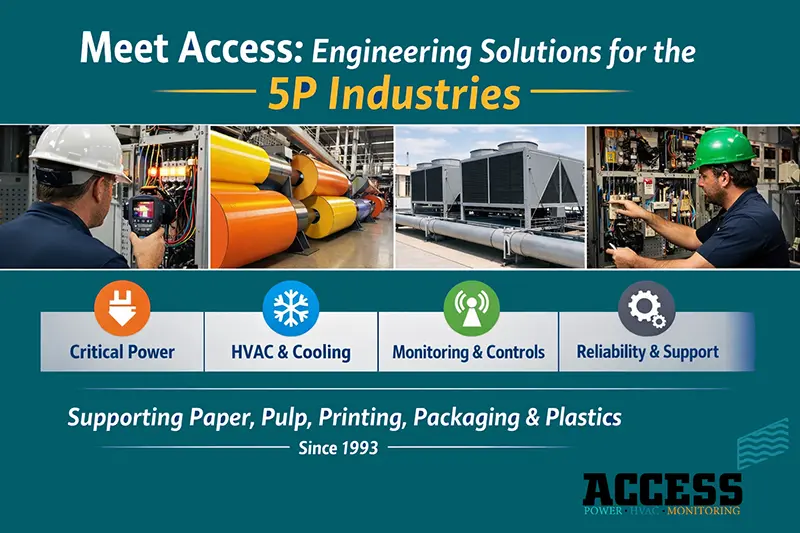
Our work generally falls into four closely connected areas.
Critical Power
Manufacturing facilities depend on electrical systems that must perform predictably during normal operation, maintenance events, and abnormal conditions. We work alongside plant and facility engineers to evaluate power distribution, power quality, power conditioning, backup strategies, and protective coordination. The objective is not simply redundancy. It is clarity around how systems behave under stress and where failure modes exist.
Critical Cooling
Cooling challenges are no longer limited to comfort or isolated equipment rooms. Controls, drives, automation systems, and compute-dense equipment generate heat levels that many legacy designs were never intended to handle. We help teams assess airflow, thermal capacity, and resilience, particularly in spaces that are being repurposed to support higher heat densities.
Monitoring and Controls
One of the most common gaps we see in manufacturing environments is visibility. Equipment may be operating, but teams often lack real-time insight into electrical loading, temperature, or environmental conditions. Monitoring and controls provide data that supports safer work practices, proactive maintenance, and better-informed capital planning.
Infrastructure Reliability and Lifecycle Support
Facilities evolve over time. Loads increase, processes change, and infrastructure installed decades ago is asked to support modern automation and digital systems. We help teams document the current state of their infrastructure, identify risk areas, and prioritize improvements in a practical and phased way that aligns with operational and budget realities.
Supporting the Infrastructure Behind AI and Advanced Computing
A growing part of our work involves helping manufacturers prepare for AI-driven systems inside industrial environments. While AI is often discussed at the software level, its physical infrastructure requirements are very real.
Advanced chips and compute platforms introduce higher power density, greater sensitivity to power quality, and thermal loads that can exceed traditional air-cooling limits. As a result, facilities are beginning to encounter liquid cooling approaches, advanced power conditioning, and tighter integration between electrical and mechanical systems.
These challenges are already appearing in pilot projects, inspections, and reliability reviews. Our role is to help facility teams understand what these technologies mean from an infrastructure standpoint, how they interact with existing systems, and how to support them safely and reliably in manufacturing environments that were not originally designed for this class of load.
Working Alongside Your Team
Access works collaboratively with facility and plant engineers, maintenance and reliability teams, and electrical and mechanical contractors. We see our role as a technical partner that helps align these groups around shared goals such as safe work practices, reliable systems, and clear documentation. In many cases, the most valuable outcome is not a single solution, but a shared understanding of how systems behave and where attention is best focused.
Addressing Real-World Manufacturing Challenges
Across the 5P industries, we consistently see the same pressures.
- Uptime expectations with little tolerance for unplanned outages
- Aging infrastructure supporting modern automation and digital systems
- Increasing safety and compliance requirements
- Limited maintenance resources, which makes proactive planning essential
Engineering-driven analysis and improved visibility help facilities navigate these challenges without overreacting or under-preparing.
Why We’re Contributing to GBIG
The Green Bay Innovation Group brings together leaders who care deeply about the future of manufacturing in this region. This article series is not intended to promote products or solutions. It is meant to share perspective, clarify standards, and provide practical insight that facility teams can apply regardless of vendor or approach.
Where Reliability Conversations Usually Begin
Many of the conversations we have with manufacturing teams start with a simple question: do we actually know where our infrastructure risks are today?
Sometimes the answer is yes. More often, the answer is unclear. As facilities evolve, loads increase, and new technologies are introduced, that uncertainty tends to grow quietly in the background.
Making those risks visible, understandable, and manageable is often the first step toward improving reliability and safety.
What’s Coming Next
In upcoming GBIG newsletters, we will explore why infrastructure reliability is becoming a competitive advantage in manufacturing, what recent changes to electrical maintenance standards mean for facilities, how electrical safety and uptime intersect, and how AI, monitoring, and advanced controls are changing infrastructure requirements.
Our goal is to support informed conversations and better decisions across the GBIG community.