
Introduction

The National Fire Protection Association’s NFPA 70B has long been a trusted guide for electrical equipment maintenance, but the 2023 edition transformed it from a recommended practice into a mandatory standard.
This change, effective January 16, 2023, means that facility owners and managers now have a formal obligation to develop and follow an Electrical Maintenance Program (EMP) for their power distribution systems.
In industries such as print, pulp, paper, packaging and plastics, collectively known in Wisconsin as the 5P industries, these changes are particularly significant. These sectors employ roughly 150,000 people in Wisconsin alone and depend heavily on reliable electrical systems to keep operations running.
For the general managers who oversee production lines and budgets, NFPA 70B compliance is not simply a checkbox. It is a pathway to lower risk, reduced downtime, improved safety, and longer equipment life.
Why NFPA 70B Matters for the 5P Industries
Electrical distribution and power-transfer systems are among the leading causes of industrial fires. Unmaintained or poorly maintained equipment is a key contributor to failures, fires, and unplanned outages.
NFPA 70B aims to break this cycle by mandating proactive maintenance and documentation to improve safety and reliability.
For 5P businesses, compliance offers tangible benefits:
Reduced Downtime and Waste
Condition-based maintenance catches problems before they cause shutdowns. Thermal imaging and other predictive testing can uncover loose terminations, overloaded circuits, deteriorating breakers, and hidden heat buildup before production is affected.
Enhanced Safety
By addressing the condition of maintenance, NFPA 70B reduces the likelihood of arc flash incidents, shocks, and fires.
Our engineering team has worked with facilities over the years that experienced serious electrical failures, including arc flash events. While every case is different, common themes often emerge: deferred maintenance, aging gear, contamination, loose connections, and equipment that had not been evaluated in years.
In many cases, modest proactive maintenance steps may have identified warning signs earlier.
Lower Operational Costs
Preventive maintenance extends equipment life and reduces expensive emergency repairs. Regular breaker maintenance, cleaning, testing, lubrication, and calibration can prevent nuisance trips and catastrophic failures.
Regulatory and Insurance Compliance
Insurers and regulators increasingly expect adherence to recognized maintenance standards. Non-compliance can lead to denied claims, higher premiums, and liability exposure.
Key Requirements of NFPA 70B
The heart of NFPA 70B is the Electrical Maintenance Program (EMP). Chapter 4 makes clear that the equipment owner must implement and document an EMP.
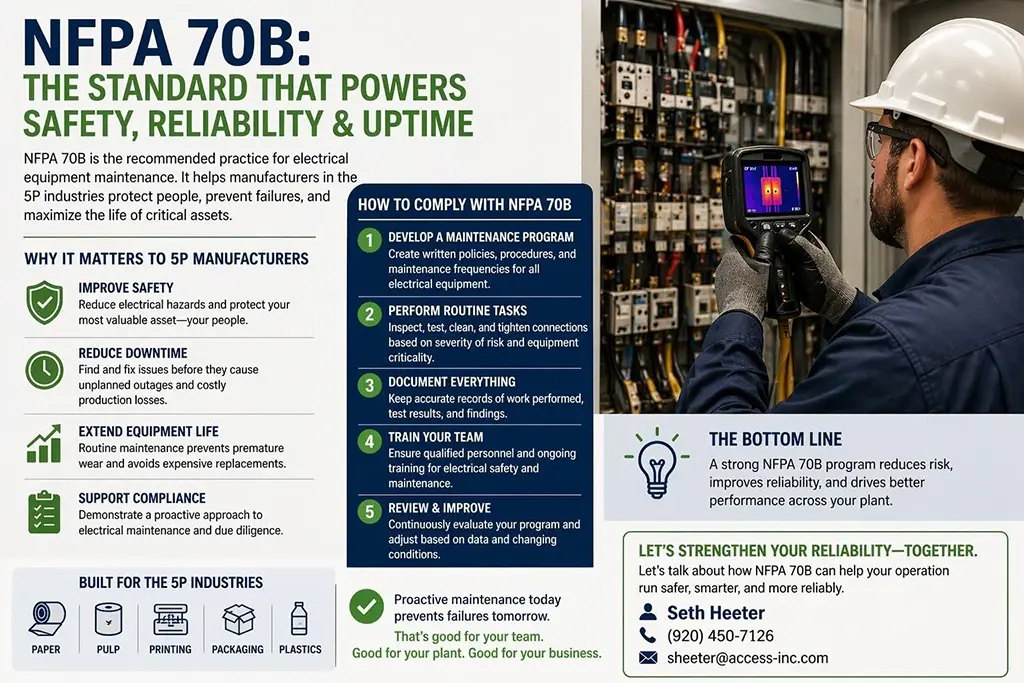
The EMP should include:
- Electrical safety procedures tied to maintenance conditions
- Qualified personnel responsible for program execution
- Survey and analysis of electrical assets and priorities
- Written maintenance procedures
- Inspection, servicing, and testing plans
- Documentation and record retention
- Corrective action processes
- Maintainability planning for upgrades and new installations
- Ongoing review and continuous improvement
Condition-Based Maintenance and Equipment Assessments
The 2023 version of NFPA 70B introduced Equipment Condition Assessments (ECAs), helping determine maintenance intervals based on:
- Physical condition
- Criticality to operations
- Operating environment
This allows maintenance resources to be focused where they create the most value.
For example, a main production transformer feeding a converting line should likely receive a different maintenance priority than a lightly used secondary panel.
Thermal Imaging and Testing
Infrared thermography remains one of the most effective tools for early detection of electrical issues.
IR scans can identify:
- Loose or failing connections
- Overloaded conductors
- Imbalanced loads
- Hot breakers or fuses
- Transformer concerns
Additional maintenance and testing may include:
- Breaker testing
- Insulation resistance testing
- Relay testing
- Power quality review
- Battery testing
- Visual inspections
- Torque verification
These services are commonly performed by larger engineering and field service organizations with dedicated technical teams, proper test equipment, and experience across complex industrial and mission-critical environments.
Implementation Steps for Compliance
A practical roadmap often includes:
- Assign an EMP coordinator
- Inventory electrical assets
- Review one-line diagrams and studies
- Develop maintenance schedules
- Conduct routine inspections and testing
- Document findings and repairs
- Prioritize corrective actions
- Review and improve regularly
Why This Matters in Wisconsin Right Now
Many Wisconsin manufacturing facilities continue operating with aging but serviceable infrastructure.
That does not automatically mean replacement is necessary.
However, it does mean proactive maintenance, testing, modernization planning, and engineering review become increasingly important.
Across Wisconsin, organizations like Access are bringing the same engineering discipline used in mission-critical facilities, data centers, healthcare, and industrial environments into manufacturing plants that depend on uptime every day.
With a deep internal team of engineers and technical specialists, these capabilities go well beyond a single individual or a small contractor model.
Conclusion
NFPA 70B’s transition to a mandatory standard reflects a broader shift toward proactive maintenance and safety.
For the 5P industries, where continuous production and high energy demands make outages costly, adopting NFPA 70B can improve reliability, protect employees, and reduce total cost of ownership.
By implementing a structured EMP, conducting condition-based maintenance, and documenting the process, businesses position themselves for safer operations and stronger long-term performance.
If you would like to discuss how NFPA 70B may apply to your facility, or would like to connect with one of our engineering resources for an initial conversation, please reach out.
Seth Heeter
President, Access
(920) 450-7126
sheeter@access-inc.com