
By Andrew Brooks, Water-based Inks and Coatings Product Manager at Sun Chemical
In today’s corrugated packaging industry, plant managers are pressed to deliver faster turnaround times and higher print quality. This challenge leads to a crucial operational decision: Should a plant mix its own inks with an in-house ink kitchen (a system for dispensing and blending base ink components), or continue purchasing finished, pre-mixed inks from ink suppliers? The right answer isn’t just about cost―it impacts labor, workspace, supplier relationships, and the plant’s future growth. To make the best choice, managers need to understand both the visible and hidden factors of each approach.
The In-House Ink Kitchen (Dispensing System)
Pros
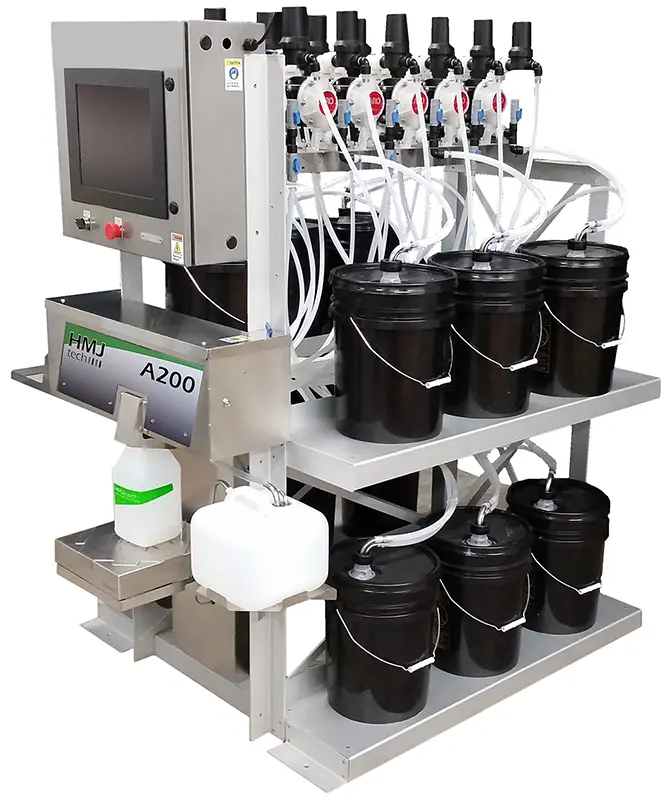
- Cost Savings: Generally, due to high production volume, buying base ink components and extenders (materials used to make the finished ink) is usually less expensive than purchasing a finished ink, especially for custom colors or small batches. However, for high-volume colors like GCMI 75 Red (a standard red ink commonly used in corrugated packaging), large ink suppliers often achieve greater efficiency and lower costs by producing these in bulk.
- Inventory Control: Only the ink quantity that is needed is dispensed, minimizing “dead” inventory (unused ink). Suppliers typically sell inks in minimum quantities (such as 40–45 pounds), which can result in waste if the job requires less. In house dispensing allows for “fit for use lot” sizes―in other words, only enough ink for each job is prepared, which keeps ink waste at a minimum.
- Operational Flexibility: If a job runs out of a color during production, or a spill happens, a new batch can quickly be dispensed―reducing costly downtime while waiting for a replacement delivery.
Cons
- Capital Expenditure (CAPEX): Setting up an ink kitchen requires an upfront investment and ongoing maintenance. Some plants do not take this into consideration by signing long-term contracts with ink vendors who provide the ink dispenser as part of their service. Pro-tip: Evaluate the merits of the ink and service first, only then consider including the equipment as part of the overall package.
- Labor & Expertise: While modern dispensers are user-friendly, the best results come from having a dedicated ink room team. Maintaining consistency in color despite changes in pH, substrate, or anilox wear, for example, requires expertise. Pro-tip: consider the headcount for the dedicated expert support needed, or a backup for when that expert is not available.
- Reduced Vendor Consultancy: When a plant mixes their own ink, the “hands-on” engagement with the supplier who is intimately familiar with the daily runs can be lost. This “knowledge fog” may make it harder for vendors to offer productivity advice or training.
Buying Finished Ink (Pre-Mixed)
Pros
- Simplicity: For smaller plants or those with low color complexity, buying pre-mixed inks is straightforward. There’s no equipment to maintain and no manufacturing guesswork―just “buy and run.” An ink kitchen can always be added later if needed. Pro-tip: Don’t invest in a dispenser unless you plan to use it.)
- Batch Consistency: Most ink kitchen operations are built around producing one pail of finished ink at a time. Maintaining Quality Control (QC) pail-to-pail can be difficult with small in-house batches. Outside vendors mix in larger volumes with established QC standards, generally ensuring higher consistency across a long run.
- Space Requirements: Purchasing finished inks frees up valuable floor space, which would otherwise be needed for dispensing equipment, storage, and QC equipment. If an in-house kitchen isn’t located near the pressroom, any productivity gain is lost due to time spent moving ink.
Cons
- Premium Pricing: The cost of finished inks normally includes supplier labor, overhead, and shipping costs. Single-pail production, especially when custom color matching is involved, can be inefficient, resulting in higher prices―especially for small orders.
- Logistical Risks: A plant production schedule is entirely dependent on the supplier’s delivery window, which can be longer for custom colors. On the other hand, a plant that has the material (bases and vehicle) in-house to mix the finished ink can meet last-minute customer orders, and avoid delays due to supply chain or weather disruptions, not impacting the ability to meet production goals
Other Factors to Consider
- Product Mix: If a plant mostly prints jobs using a single color, such as 75% GCMI 90 Black―a standard black ink for shipping boxes, there’s generally little benefit to in-house mixing. But if a plant regularly produces full-color jobs, for example, point-of-purchase displays needing 40–50 different colors monthly, in-house capabilities can be advantageous.
- Dispenser Types: There are three major dispenser models in the corrugated industry, each offering different features and sizes. Choosing the right hardware, and features, is essential.
Decision Framework: Practical Checklist for Plant Managers
- How many colors do jobs require monthly? If more than 20–30, consider in-house capabilities.
- What percentage of jobs use standard inks (like GCMI 90 Black or GCMI 75 Red)? If over 75%, finished inks are likely more efficient.
- Is the facility equipped with staff who can manage ink mixing and quality control? If not, finished inks may be easier.
- Is there enough floor space near the pressroom for an ink kitchen?
- Consider cost of the initial investment and ongoing maintenance for dispensing equipment.
- How critical is immediate color adjustment during production? If high, in-house mixing is beneficial.
- Are there frequent supplier deliveries delays? If high, in-house mixing is beneficial.
The Bottom Line
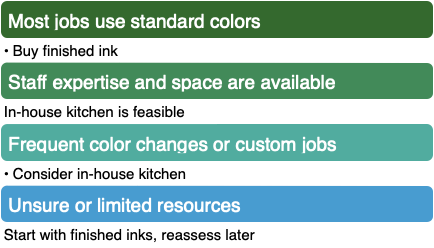
There’s no universal answer to the ink kitchen dilemma. Finished inks provide simplicity, minimal overhead, and standard QC―ideal for smaller plants or those with low color diversity. For plants needing quick color changes and high specialty color turnover, an in-house ink kitchen offers cost savings and flexibility. Conduct a pressroom audit to evaluate waste, labor, and color needs before deciding. The choice made will shape the plant’s operations for years to come―so it needs to be approached thoughtfully and objectively.
For additional information, visit: www.sunchemical.com/flexible-packaging-solutions/