
By: Seth Heeter
President, Access
Chair, Wisconsin AI Infrastructure Initiative
Neenah, Wisconsin
sheeter@access-inc.com
(920) 450-7126
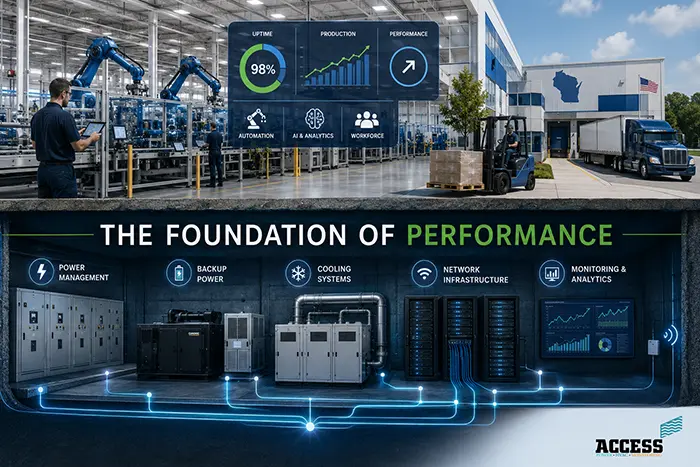
Ten years ago, many manufacturing leaders viewed infrastructure reliability as a cost center — something to be minimized, deferred, or pushed to the back of the budget queue. Today, that thinking is shifting. For manufacturers competing in a labor-constrained environment with higher automation dependency and tighter margins,
infrastructure reliability has become one of the clearest competitive advantages available.
The Landscape Has Changed
Wisconsin manufacturers face four simultaneous pressures. First, the labor shortage is real. Skilled workers are harder to find and retain. The plants that survive are the ones that make existing workers more productive, not the ones asking for more headcount.
Second, automation dependency keeps rising. Machines, controls, variable frequency drives, and data systems are no longer optional — they’re core to production. And every automated system depends on reliable power, cooling, and network infrastructure.
Third, scheduling is tighter. Customers expect faster turnarounds, smaller batch sizes, and on-time delivery. An unplanned outage that once cost a day now costs a week of missed commitments.
Fourth, infrastructure is aging. Many facilities operate 30+ year-old electrical and mechanical systems. Some of that equipment is reliable, but reliability by accident is not a strategy.
How Reliability Becomes Competitive
In this environment, a facility with predictable uptime is a facility with real advantage.
Uptime means productivity. Downtime means waste — not just lost production, but inefficiency across the entire system. Workers idle. Orders delayed. Capacity unused. When labor is scarce and expensive, downtime becomes exponentially more painful.
Uptime means customer confidence. A manufacturer that consistently meets delivery commitments wins repeat business and higher margins. A manufacturer known for surprises and delays does not.
Uptime means the ability to invest in growth without fear. A plant with aging but well-maintained infrastructure can confidently add new production lines or automation. A plant with failing systems cannot — it’s chasing fires instead of building the future.
Uptime also means operational resilience. When labor is tight, the plants that keep running smoothly can retain people. Plants that shut down unexpectedly or run inefficiently lose workers to competitors who offer stability.
AI and Automation Amplify Reliability Needs
This is where AI and advanced automation change the equation.
As manufacturers invest in AI-driven production systems, machine vision, predictive maintenance platforms, and real-time analytics, they become more dependent on infrastructure. A power disturbance that once affected a few computers now impacts automation systems, production data, quality processes, and business operations simultaneously.
The plants getting the most value from AI are the ones that have clean, reliable power and cooling infrastructure to support it. Conversely, unreliable infrastructure limits how much AI a facility can actually deploy — because the infrastructure itself becomes the bottleneck.
This creates a strategic insight: Reliable infrastructure is not an obstacle to digital transformation. It’s a prerequisite.
What Competitive Advantage Looks Like in Practice
We work with 5P manufacturers that have deliberately invested in infrastructure reliability. The results are measurable:
- Facilities with condition-based maintenance programs and real-time monitoring experience fewer unplanned outages. That means tighter production schedules, higher capacity utilization, and lower cost per unit.
- Facilities with documented electrical systems and thermal imaging can onboard automation and AI faster because they understand their power and cooling constraints upfront.
- Facilities with strong infrastructure visibility can respond to customer demands faster — adding new production lines, scaling up capacity, or pivoting to new products without worrying about infrastructure limits.
- Facilities with predictable operations retain employees better. Workers prefer working at plants that run smoothly.
From Cost Center to Competitive Asset
The shift from viewing infrastructure as a cost to viewing it as a competitive advantage requires a change in mindset. It’s not about spending more money. It’s about spending money strategically — on visibility, preventive maintenance, condition assessment, and planning.
The question manufacturers should ask is not “How do we minimize infrastructure costs?” but “What infrastructure investments unlock the most productivity, flexibility, and growth?”
For many Wisconsin facilities, that answer starts with understanding their current power, cooling, and operational
constraints. From there, the path forward becomes clear.
Bottom Line
In a labor-constrained manufacturing environment with rising automation dependency and tighter margins, reliable infrastructure is no longer a nice-to-have. It’s a strategic business advantage. The manufacturers that recognize this
— and invest accordingly — will be the ones that compete effectively in the next decade.
If you’d like to discuss how infrastructure reliability could unlock competitive advantage at your facility, reach out.
We help manufacturers think strategically about power, cooling, monitoring, and operational continuity.
Seth Heeter
President, Access
(920) 450-7126
sheeter@access-inc.com
Access helps manufacturers, healthcare organizations, utilities, and mission-critical facilities improve reliability through power, cooling, monitoring, and infrastructure engineering solutions across Wisconsin and throughout the world.