By Susan Stansbury, Industry Consultant
Every day we hear about what AI can do in our lives and businesses. In manufacturing, we are most focused on efficiency, now being delivered by AI with new break-through results.
“The number one thing in this month’s meeting with Chinese Premier Xi has to be AI.”
– Sean Patrick
Maloney, attorney-politician; current president of Coalition for Prediction Markets.
According to pundits, the U.S. still leads in advanced chips for AI where China’s competitive strength is in rare earth minerals. As artificial intelligence transforms manufacturing, the need for high-performance chips built specifically for AI rollouts has exploded.
Across industries and countries, manufacturers are investigating what AI can do for their business. According to Matthew Putman writing in Forbes last year, “Manufacturers know automation is the future but the path to get there isn’t always clear. What does it actually take to transition from manual operations to AI-driven automation? he asks. Putman outlines, steps that any company, large or small, can follow. It begins with reviewing your operations to identify opportunities, such as:
- Looking at repetitive, resource-intensive tasks that can benefit from AI.
- Quality, where products fall short of perfection, and manual aspects.
According to Putman, starting with specific efforts is a good way to begin, such as: “Implementing AI for visual inspections can significantly reduce defects and waste, paving the way for broader adoption. Early wins not only build momentum but also familiarize teams with AI’s capabilities.”
Higher productivity, superior input tools in real time, fewer defects, and an improved safety environment are major benefits of automation-driven AI.
Manufacturers are leveraging AI-driven process control systems to analyze batches of products at various processing stages. AI systems identify opportunities in equipment performance, allowing companies to monitor and observe indicators such as productivity, waste, energy use and uptime.
Thinking of the longer term, manufacturers are looking at scalable investments in AI. New AI systems can interface seamlessly with existing equipment, controls and sensors. According to Enerlligence Analytics, with 5000 Linkedin followers, “Industrial AI becomes far more valuable when it is embedded directly into the workflows engineers already use. Combining…can shorten development cycles, reduce operational risk and help skilled teams achieve more without adding headcount.”
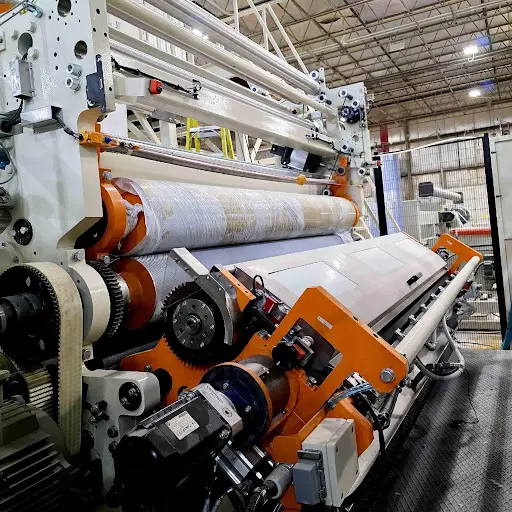
Transitioning to an AI-driven factory requires communications across employee departments a simultaneous commitment. Understanding advanced manufacturing with automated-AI is actually a partnership realized through employee training.
Intelligence around AI worldwide and industry-wide is occurring right now. For example, INDA (International Nonwovens Disposables Association) is conducting a survey aiming to gather insights from companies and professionals across the nonwovens value chain. The findings will help identify key trends, challenges, opportunities, and priorities shaping the future of the industry worldwide, including the status of AI.
Worldwide, the leaders are the U.S. and China. Alex Nubla, writing for the AI Council says:
Framing the US-China AI dynamic as a race to the top misses the bigger picture. We are not just witnessing a race – we are witnessing a divergence in strategy.
The US is heavily focused on Frontier AI – pushing the absolute boundaries of what is computationally and theoretically possible. The US focus is on building the “tip of the spear” models with massive parameter counts, immense reasoning capabilities, and general-purpose versatility.
China is heavily focused on Applied AI – industrializing, optimizing for cost, and embedding it into daily lives….