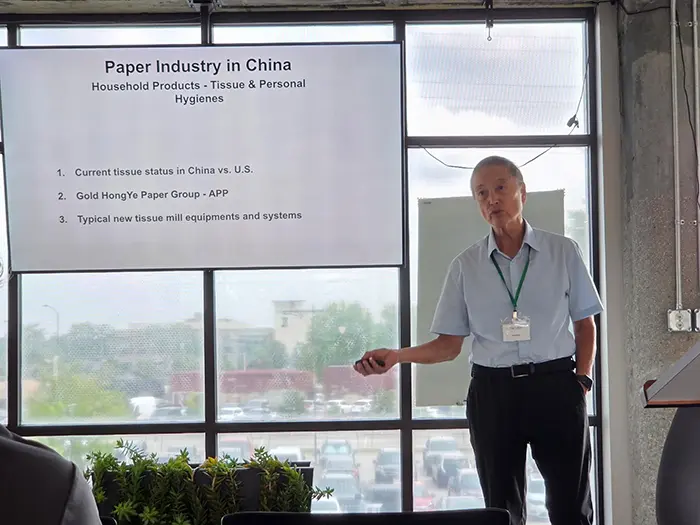
We want to thank Jeff Lindsay of Planet Lindsay, Pat Chen, and Brit Swisher of Midland Paper Company for an outstanding presentation on Asia Pulp and Paper.
Brit Swisher’s presentation was an overview of the US and Asian Paper Market

- The advantage is shifting from tons to knowledge.
- What executives should be watching?
- Operational Impact on Production
- US Paper Manufacturing is focusing on Profitability not Tons.
- The impact of EPR – Extended Producers Responsibility
- Current Challenges and Opportunities
- Process Improvement
- Sustainability
- R & D Trends shaping the next product generation of paper products
- Strategies for the Market – What is Happening
- Offshore imports on All Printing Grades and current updates on the US Producers
- Tarriff & Duties, the current and future policies
- Paper and Pulp Mill closures in the USA and China
- How Global manufacturers shape the US Market
- The U.S. Paper Industry at an Inflection Point
Jeff Lindsay focused on the history of China and its evolution moving from agriculture to an industrial manufacturing powerhouse. Pat Chen focused on the technology and investments that have and will continue to being made by China’s Paper and Pulp Manufacturers!
China’s paper industry is one of the clearest examples of a shift from a rural, agricultural economy to a highly industrialized manufacturing powerhouse. This story is especially relevant to Wisconsin and the broader U.S. paper and pulp industries. China did more than increase paper production; it rebuilt the entire industrial ecosystem around paper, pulp, packaging, machinery, planning, recycling, chemicals, energy, and technology. Before economic reforms began in 1978, China’s paper industry was small, fragmented, and technologically outdated, with companies relying on non-wood fibers. Those reforms dramatically changed the business environment by encouraging rural enterprises, private businesses, foreign investment, industrial development, and export-oriented manufacturing. The critical shift from small mills to large, modern mills transformed the structure of the industry.
A 2007 national paper-industry policy called for China to move from being a minor paper-producing country toward becoming a paper-manufacturing powerhouse, emphasizing larger-scale companies, better technology, improved environment performance, resource efficiency and the integration of forestry and paper making.
The Government policy + private capital + foreign technology + enormous domestic demand + export opportunities lead to rapid industrial modernization. We see Asian Pulp and Paper establishing plantations in China to support the production of pulp with less dependence on foreign pulp suppliers.
China produced approximately:
- 136.25 million tons of paper and paperboard
- 94.54 million tons of pulp
- 65.14 million tons of paper products
The broader pulp, paper, and paper-products sector produced 296 million tons and generated approximately 1.46 trillion yuan in revenue.