
By Joan Koehne
GBIG Board Secretary
Writer to the Rescue
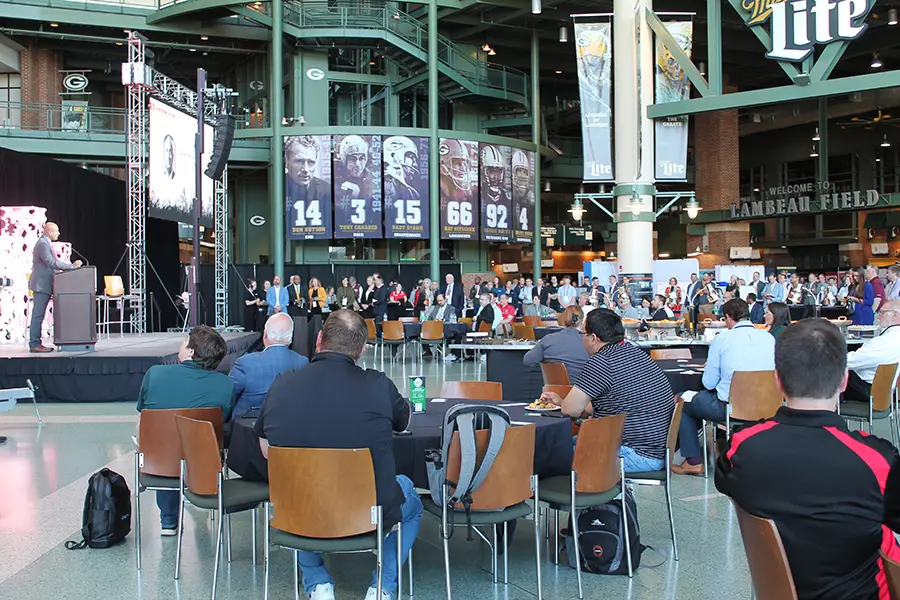
Wisconsin’s manufacturing industry came together for a two-day summit on June 1 and 2 at the Lambeau Field Atrium in Green Bay. The Wisconsin Drives Manufacturing Summit attracted academic and industry leaders who talked about the challenges and opportunities manufacturing companies face today. The UW-Madison Grainger Institute of Engineering organized the event, and Green Bay Innovation Group signed on as a co-sponsor. Nearly 700 people registered for the summit.
Rockwell Automation: The Next Era in Manufacturing
Bob Buttermore, Senior Vice President and Chief Supply Chain Officer of Rockwell Automation, told the audience that we create a stronger Wisconsin together. “We need to work together across the organization as one team to drive innovation,” he said. Manufacturing is a key economic generator in Wisconsin. “Manufacturing has been a heart of our communities,” he said. “What you do in this room matters.”
Bob said it’s an exciting time to work in manufacturing, especially with technology transforming the industry. Today’s manufacturers deal with market disruption and volatility, driving the industry to rewire the global supply chains. AI automation is revolutionizing the supply chain, giving the industry opportunities to combat the shortage of labor and transform manufacturing in the U.S. As a result, manufacturers can provide a better customer experience and still remain competitive.
“Transformation has to happen with ROI,” Bob said. He challenged manufacturers of small, medium and large manufacturing companies to empower their workforce. “Perform and deliver for your customers every single day,” he said.
Integrating Automation, Robotics and AI
Bob spoke about world-class manufacturing facilities in Singapore and how Rockwell Automation is bringing this advanced technology to the company’s Wisconsin facilities. The Singapore site uses automation, robotics and AI extensively. He described four ways to optimize end-to-end processes across the supply chain.
- The Singapore facility used a digital twin, a virtual replica of a physical asset.
- The facility automated some processes that it had never automated before. Innovative use of robotics decreased labor by 33%.
- The facility also reduced its carbon footprint with the aid of energy management software.
- AI-integrated training programs made training 67% faster. Technicians learned to troubleshoot and repair systems in 4 months instead of 9-12 months.
Developing a Highly Skilled Workforce
In addition to developing technology, Bob emphasized the importance of developing people. “Technology is driven by people,” he said. He also recommended redundancy, advising manufacturers to build the same product in two different locations to maintain a resilient supply side. Tight cyber security protections were another recommendation. He also promoted disciplined innovation, advising manufacturers to come up with one or two use cases, then develop and scale. He spoke about partnering with schools, government agencies, and other organizations to attract more people to the manufacturing industry. The future of manufacturing depends on a skilled workforce.
The Rockwell Automation presentation was one of dozens of presentations focusing on the next era in manufacturing.