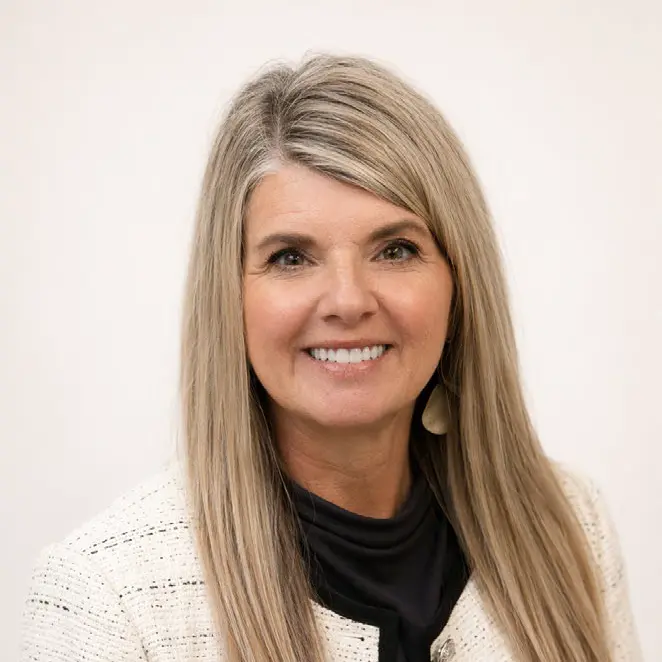

Jill Fuss is a Vice President of Business Development at Brown & Brown, where she partners with employers across Wisconsin to deliver comprehensive risk management and insurance solutions. Jill works with clients to support both employee benefits and property and casualty needs, helping organizations take a well-rounded approach to protecting their people, assets, and long-term success.
With a strong focus on relationship-building and innovative problem-solving, Jill guides clients through an increasingly complex landscape. A hallmark of her approach is her commitment to truly understanding each prospect’s vision. She prioritizes getting to know her clients on a deeper level by learning what they want to accomplish, what success looks like for their organization, and how their long-term roadmap is evolving. By building meaningful personal relationships alongside professional partnerships, Jill develops customized strategies that align with business goals and deliver lasting value.
Known for her collaborative, client-first mindset, Jill brings positive energy, insight, and a genuine passion for helping businesses grow with confidence. She is dedicated to providing transparency, education, and thoughtful guidance to every organization she serves.
Outside of Work
Outside of her professional role, Jill is a proud mother of two beautiful daughters and a loving grandmother to three grandsons who keep her active and inspired. She is the wife of Chris, owner of Titletown Manufacturing LLC., and together they share a strong appreciation for entrepreneurship and community. Jill is also a devoted dog mom to Boomer and Lucky. In her free time, she enjoys traveling to her cabin on Little Bay de Noc, where she finds peace in watching the sunset and spending quality time with family.
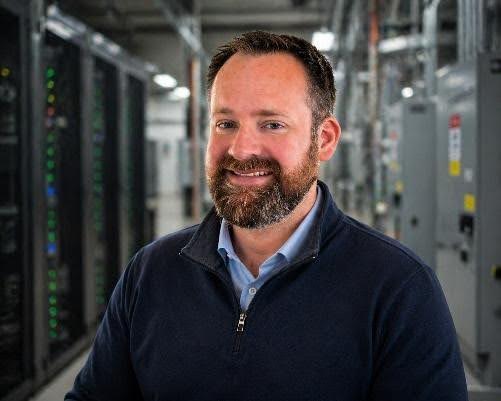
Seth Heeter President, Access Chair, Wisconsin AI Infrastructure Initiative
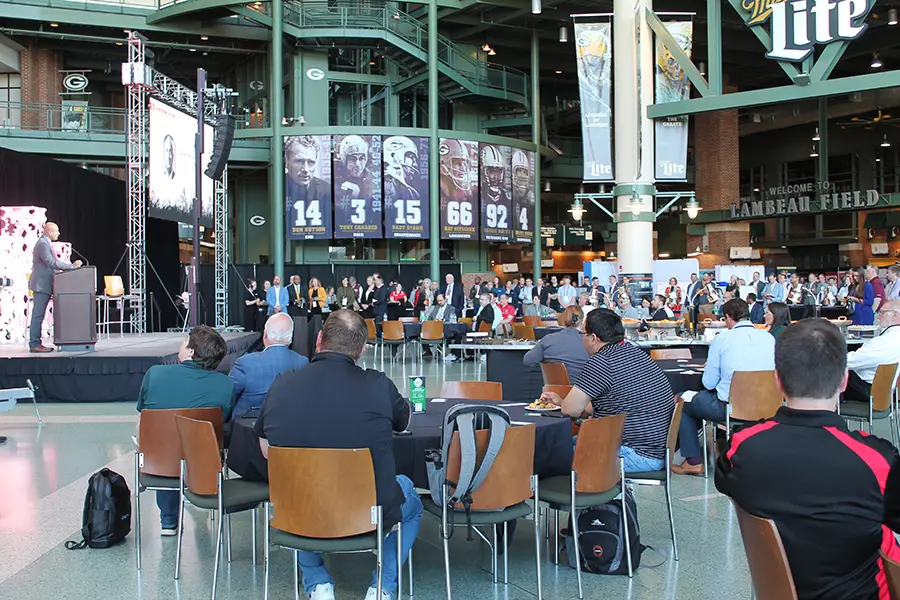
Recently, I had the opportunity to attend the Wisconsin Drives Manufacturing Summit at Lambeau Field in Green Bay. While the venue itself was impressive, what stood out most were the conversations taking place throughout the event.
One theme consistently rose to the top:
Wisconsin’s workforce challenges are no longer a future concern. They’re a current reality.
Manufacturing remains one of Wisconsin’s greatest strengths, employing hundreds of thousands of people across the state and contributing significantly to our economy. Yet many manufacturers are facing the same question:
“Where will the next generation of workers come from?”
Several presenters highlighted a sobering reality. Wisconsin’s population is aging, workforce participation has declined, and the pipeline of skilled labor is becoming increasingly constrained. At the same time, manufacturers are being asked to produce more, respond faster, and remain globally competitive.
For years, many organizations viewed automation as a way to reduce labor. Increasingly, that mindset is shifting.
The discussion at the summit focused less on replacing people and more on helping existing teams accomplish more with the resources available. Artificial intelligence, automation, advanced analytics, robotics, and digital technologies are becoming workforce multipliers that allow experienced employees to focus on higher-value work while repetitive tasks are handled automatically.
The question manufacturers should be asking is no longer whether AI will impact their operations.
The question is how quickly.
The Infrastructure Side of AI
When most people hear “AI,” they think about software.
What often gets overlooked is the physical infrastructure required to support it.
Whether AI workloads run inside your facility or in a remote cloud environment, the computing power behind those applications requires reliable electrical systems, cooling infrastructure, network connectivity, and continuous monitoring.
The rapid growth of AI is one reason we continue to see significant investment in data centers, semiconductor manufacturing, and digital infrastructure across the country.
Those facilities consume enormous amounts of power and generate substantial heat, creating new demands on electrical and mechanical systems.
Even manufacturers that never build their own data center will feel the impact.
AI-driven production systems, machine vision, predictive maintenance platforms, digital twins, advanced automation, and real-time analytics all increase dependence on reliable technology infrastructure. A power disturbance that once affected a few computers may now impact production data, automation systems, quality processes, and business operations simultaneously.
Reliability Becomes a Competitive Advantage
As manufacturers continue investing in digital transformation, reliability becomes more important than ever.
The organizations that successfully leverage AI and automation will not simply be those with the newest software. They will be the companies that build resilient infrastructure capable of supporting these technologies year after year.
That means paying closer attention to:
Electrical system reliability
Cooling capacity and efficiency
Network resilience
Environmental monitoring
Backup power systems
Predictive maintenance programs
These aren’t just facility concerns anymore. They are business continuity concerns.
As manufacturers continue evaluating AI, automation, and digital transformation initiatives, one question is becoming increasingly important:
Is your facility infrastructure prepared to support what’s coming next?
The answer often starts with understanding your existing power, cooling, and monitoring capabilities before capacity, reliability, or uptime become concerns.
Looking Ahead
One message from the summit stood out to me.
The future of manufacturing will be shaped through collaboration between industry, education, technology providers, and manufacturers themselves. Wisconsin’s manufacturing community has always found ways to adapt, innovate, and compete.
The labor challenges we face are real. But so are the opportunities.
Artificial intelligence and automation are not replacing Wisconsin manufacturing. They are helping manufacturers accomplish more with the talented people they already have.
AI may be the headline.
But reliable power, cooling, monitoring, and infrastructure resilience are what will make that future possible.
Seth Heeter President, Access
Access helps manufacturers, healthcare organizations, utilities, and mission-critical facilities improve reliability through power, cooling, monitoring, and infrastructure engineering solutions across Wisconsin and throughout the world.
VARC Builds on VPI Legacy to Expand Packaging and Assembly Capabilities Across Wisconsin
VIROQUA, WI. — Following its January 1 merger with Fox Valley-based VPI, VARC, Inc. is expanding its packaging, assembly, and fulfillment operations to better serve manufacturers and distributors across Northeast Wisconsin and beyond. By building on VPI’s long-standing reputation in the region, VARC is strengthening its ability to deliver flexible, high-quality production solutions while increasing capacity for business partners.
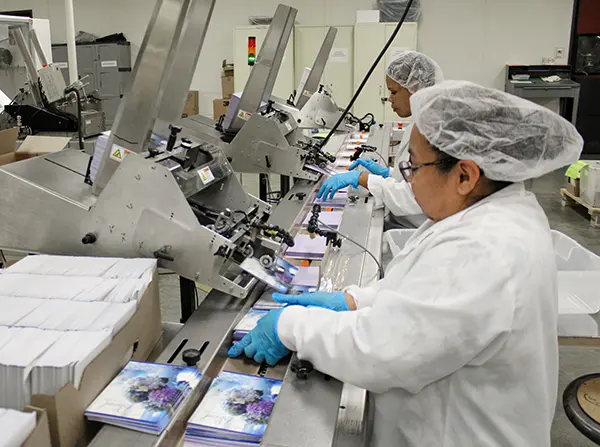
The integration brings together complementary expertise, combining VPI’s experience in large-scale packaging operations with VARC’s established assembly and fulfillment services. As a result, VARC now offers a broader range of subcontract services, including kitting, sealing, labeling, inspection, inventory control, and warehousing.
VARC’s operational footprint has also significantly expanded, with locations spanning Viroqua, La Crosse, Reedsburg, Mauston, Racine, Burlington, and Appleton. This expanded network provides increased capacity, improved logistics, and greater responsiveness for partners throughout the Fox Valley and across Wisconsin.
“Our focus has been on building stronger operations and expanding opportunity,” said Elizabeth Filter, President and Chief Executive Officer of VARC. “By aligning our capabilities and investing in growth, we are better positioned to serve our business partners while continuing to create meaningful employment opportunities in the communities where we operate.”
Tim Riebau, who previously served as President & CEO of VPI and now serves as Chief Operating Officer for VARC, added, “This next chapter allows us to build on VPI’s strong foundation in the Fox Valley while expanding the resources and capabilities available to our customers. Together, we are creating greater efficiency, increased capacity, and more opportunities for growth.”
Filter, who has led VARC through a period of significant organizational growth, continues to guide the combined organization’s mission-driven approach to workforce development. Under her leadership, VARC connects business needs with a reliable, inclusive workforce while delivering high-quality results and creating employment opportunities for individuals of all abilities.
As VARC continues to grow, the organization remains committed to strengthening partnerships across Northeast Wisconsin and the broader region, supporting local manufacturers, enhancing supply chain solutions, and driving both economic and community impact.
About VARC
Founded in 1975 in Viroqua, Wisconsin, VARC serves over 2,500 individuals with varying abilities across 18 locations, including eight production facilities. Guided by its mission “to support and empower children and adults with disabilities and other life barriers to build greater independence and community inclusion,” VARC provides a wide range of services including licensed childcare, adult day services, supported employment, early intervention services, trauma-informed mental health care, and school-to-work transition programming. Its production facilities partner with commercial businesses to provide co-packaging and co-assembly services, blending mission-driven impact with sustainable revenue. With a presence across much of Wisconsin, VARC empowers individuals to build independence, engage in their communities, and access meaningful, choice-driven experiences. For more information about VARC, visit varcinc.com.
The Green Bay Innovation Group Foundation thanks all golfers and hole sponsors for supporting Swing Big with GBIG Golf Outing. Proceeds from the event will be donated to six outstanding nonprofits that support our communities and education.
We have attached a list of the companies participating in the golf outing. Please review it to confirm whether you are listed! The event is close to being sold out. At check-in, please go to the pro shop and provide your company name. In cases, we have arranged foursomes for players to join, as noted on the attached list. Mid Vallee will assign carts.
I have attached for the hole sponsors assigned a hole identified as the White, Red, Blue, and a number. Pick up a map at the Pro Shop to help you find your hole. We ask that you bring your own table, chairs, tents, etc. We will have the signs set up around 8:30 a.m. and tee off is at 9:30 a.m. Mid Vallee and volunteers will be able to provide transportation.
Finally, we have a FREE NETORKING event starting at 3:00 p.m. for guests. We are expecting close to three hundred people at the event. Bring your business cards too!
Thank You, Marty Ochs Green Bay Innovation Group Foundation 608-698-3333
Wisconsin’s manufacturing industry came together for a two-day summit on June 1 and 2 at the Lambeau Field Atrium in Green Bay. The Wisconsin Drives Manufacturing Summit attracted academic and industry leaders who talked about the challenges and opportunities manufacturing companies face today. The UW-Madison Grainger Institute of Engineering organized the event, and Green Bay Innovation Group signed on as a co-sponsor. Nearly 700 people registered for the summit.
Rockwell Automation: The Next Era in Manufacturing
Bob Buttermore, Senior Vice President and Chief Supply Chain Officer of Rockwell Automation, told the audience that we create a stronger Wisconsin together. “We need to work together across the organization as one team to drive innovation,” he said. Manufacturing is a key economic generator in Wisconsin. “Manufacturing has been a heart of our communities,” he said. “What you do in this room matters.”
Bob said it’s an exciting time to work in manufacturing, especially with technology transforming the industry. Today’s manufacturers deal with market disruption and volatility, driving the industry to rewire the global supply chains. AI automation is revolutionizing the supply chain, giving the industry opportunities to combat the shortage of labor and transform manufacturing in the U.S. As a result, manufacturers can provide a better customer experience and still remain competitive.
“Transformation has to happen with ROI,” Bob said. He challenged manufacturers of small, medium and large manufacturing companies to empower their workforce. “Perform and deliver for your customers every single day,” he said.
Integrating Automation, Robotics and AI
Bob spoke about world-class manufacturing facilities in Singapore and how Rockwell Automation is bringing this advanced technology to the company’s Wisconsin facilities. The Singapore site uses automation, robotics and AI extensively. He described four ways to optimize end-to-end processes across the supply chain.
The Singapore facility used a digital twin, a virtual replica of a physical asset.
The facility automated some processes that it had never automated before. Innovative use of robotics decreased labor by 33%.
The facility also reduced its carbon footprint with the aid of energy management software.
AI-integrated training programs made training 67% faster. Technicians learned to troubleshoot and repair systems in 4 months instead of 9-12 months.
Developing a Highly Skilled Workforce
In addition to developing technology, Bob emphasized the importance of developing people. “Technology is driven by people,” he said. He also recommended redundancy, advising manufacturers to build the same product in two different locations to maintain a resilient supply side. Tight cyber security protections were another recommendation. He also promoted disciplined innovation, advising manufacturers to come up with one or two use cases, then develop and scale. He spoke about partnering with schools, government agencies, and other organizations to attract more people to the manufacturing industry. The future of manufacturing depends on a skilled workforce.
The Rockwell Automation presentation was one of dozens of presentations focusing on the next era in manufacturing.
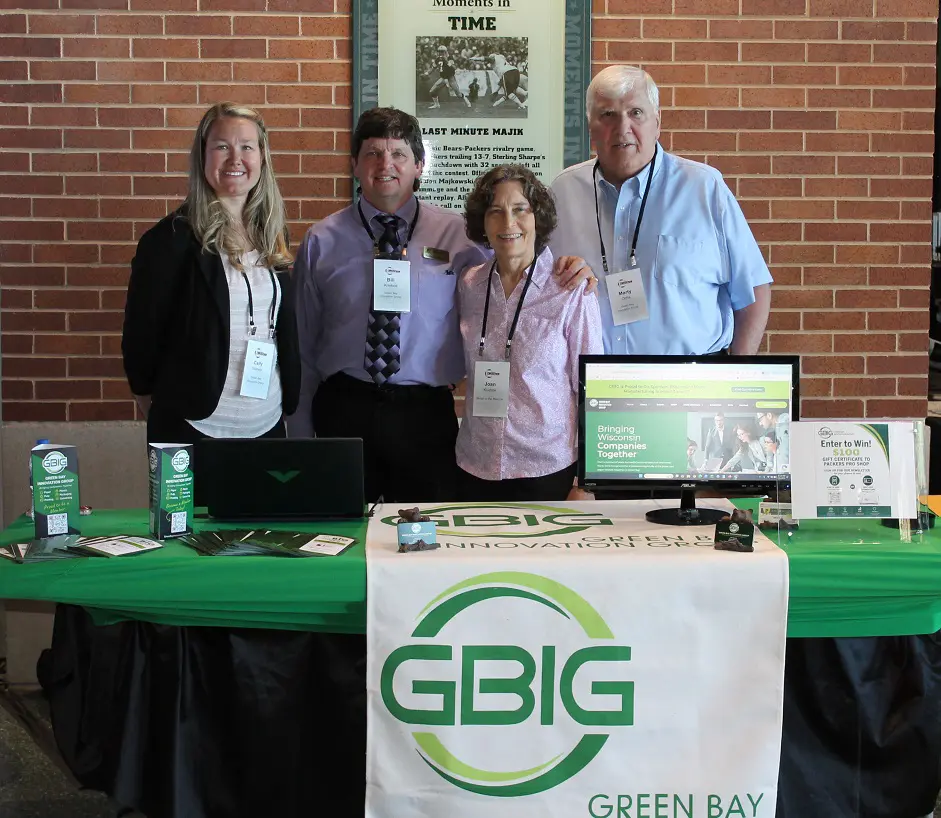
Green Bay Innovation Group took its place among the leaders of Wisconsin’s manufacturing industry at Wisconsin Drives Manufacturing Summit at Lambeau Field in Green Bay on June 1 and 2. Nearly 700 people attended the vent which featured keynote speakers, break-out sessions, networking opportunities, and expo booths. GBIG co sponsored the event, organized by the UW-Madison Grainger Institute of Engineering. GBIG board members interacted with Summit participants in the Lambeau Field Atrium, exchanging information about GBIG and other topics related to manufacturing.
Marty Ochs, GBIG Executive Director, said the Wisconsin Drives Manufacturing Summit was in a class all its own. “I’ve never seen a manufacturing event this impressive. The summit brought manufacturing and education together, with world-class presenters and cutting-edge manufacturing technologies,” he said. “We had a tremendous opportunity for learning and networking at an exceptional venue, Lambeau Field.”
Wisdom from the Harley-Davidson CEO
Artie Starrs, President and CEO of Harley-Davidson, presented the first keynote address on June 2. Drawing from his experience at the Wisconsin-based motorcycle company, Arnie encouraged attendees to understand their customers’ needs. “Do your best to walk in the shoes of your customers,” he said. He also emphasized the importance of maintaining brand integrity. Everyone working at a Harley dealership wears the company logo on their shirt. “It was a powerful statement,” Artie said.
Artie described the company’s humble beginnings in a 10 X 15-foot shed in Milwaukee to its rise as an international icon. People can see a replica of the shed at the Harley-Davidson Museum where William Harvey and Arthur Davidson designed their first motorcycle in 1903.
William and Arthur built their first factory in 1907 with the help of a $170 loan. Just 17 employees worked at Factory No. 1, and the company quickly took off. In 1913, the young company built and sold more than 17,000 motorcycles. In 1963, Harley-Davidson opened a manufacturing facility in Tomahawk, Wisconsin. It became the sole supplier of body work, with the level of craftsmanship only Harley-Davidson can achieve. Meanwhile, the world-class manufacturing facility in Milwaukee continually adapted over the decades, thanks to its highly skilled workforce.
The iconic motorcycle, designed by engineers in Wisconsin, is one of the state’s most well-known brands. Plus, Harley owners are one of the most loyal groups of riders. “We see this all around the world, people who have tattooed this brand (on their arms),” Artie said.
Harley-Davidson is a Wisconsin manufacturing success story, one of many successes showcased at the Wisconsin Drives Manufacturing Summit.
Get links to the latest news, events, stories, and interviews from our 5P news members. Our goal is to remind the decision-makers in Wisconsin of the importance of our industry both historically, and more importantly, into the future.
Read the latest 73 Stories and Links on the Internet below.
Remote and Hybrid Workplaces have been in turbo-drive since COVID. GBIG member Amundsen Davis recently presented a webcast to examine employers’ legal responsibilities for remote workers. Attorneys Ryan Young and Ann Barry Hanneman of Amundsen Davis presented “Navigating Remote & Hybrid Workplace Challenges.” This webcast is the fourth of the five-part Amundsen Davis Supervisor and Management Training Series.
Wage and Compliance for Remote Workers
Ryan Young
The attorneys discussed wage and compliance in a borderless office, noting that employers are responsible for paying for hours worked. We live in an always-on digital culture with informal conversations happening after working hours. The company can be liable to pay for these unapproved overtime hours. Thus, employers should establish black-out windows so employees aren’t working off hours and use employee discipline to stop them from working unapproved overtime. It’s important for employees to track their hours, clocking in and clocking out.
If employers underpay overtime, the employers may have to repay the wages and pay double the wages in damages. In addition, employers may be responsible for attorney fees and court costs, and these can be significant. If employers underpaid overtime for multiple employees, employers may face a class action suit. Attorney fees are much higher for class action suits, getting exponentially out of hand. Again, employers should implement a remote timekeeping policy and off-hours blocks.
Commuting & Breaks for Hybrid Employees
Attorney Young also talked about commuting. Standard travel from home to work is an unpaid commute, even for hybrid workers or remote workers when they need to report to a physical office. The time they spend commuting to and from work is not compensable.
Concerning meal and rest breaks, Wisconsin does not require employers to provide these periods. If rest breaks are voluntarily provided, short periods (under 30 minutes) must be paid, even if the employee is taking breaks in their own home.
Handling ADA Accommodations Requests
Employers also should consider the Americans with Disabilities Law guidelines for remote work. Some employees may request remote work as a reasonable ADA accommodation. Companies need to make a thorough, factual determination of the job before approving the request. The employers also should examine job responsibilities that can or can’t be performed at home.
Employers should look at the employee’s medical condition and discuss alternative accommodations for the employee to continue to work on site, if onsite work is preferred.
Anti-Harassment Policies & Investigations
The more casual tone of remote working can lead to claims of harassment, Attorney Hanneman said. Sometimes, remote working leads to more microaggressions and an increase in harassing jokes through email, phone, videoconferencing and chatting apps. Company anti-harassment policies apply to these situations, and these policies should be adapted to remote workers. Just because someone is working remote, it doesn’t mean employers can disregard harassment claims. They still have a duty to investigate claims. It’s important to set expectations for videoconference meetings for appropriate dress code and proper conduct.
Next Webcast: Managing Performance Issues
The Remote and Hybrid Worker webcast is the fourth of the five-part Amundsen Davis Supervisor and Management Training Series. The final presentation in the series will be “Managing Performance Issues Without Creating Legal Exposure” at 12 p.m. Tuesday, June 9. Attorneys Jeff Risch and Sara Zorich will be the presenters.
AHLSTROM OYJ, PRESS RELEASE, MAY 26, 2026 at 10:00 EEST
Ahlstrom, a global leader in fiber-based specialty materials, announces the launch of a new generation of glass microfiber media for HVAC filtration, designed to meet the growing demand for responsible, high-performance air filtration solutions. Produced in Turin (Italy), this new platform is made without any intentionally added PFAS while maintaining the durable water repellent properties essential for HVAC systems, enabling manufacturers to rely on safer materials without compromising functionality.
Leveraging advanced fiber engineering, the media delivers measurable performance gains – achieving up to 20% lower initial pressure drop and improved pressure buildup compared with standard glass media on the market. This contributes to better energy efficiency while maintaining stable filtration performance throughout the filter’s lifetime.
Engineered for industrial reliability, the media offers excellent processability and pleatability, helping reduce waste and limiting the risk of defects during converting. Covering particulate efficiencies from ePM1 65% to ePM1 80% (ISO 16890), the range is suitable for a broad set of HVAC applications, from residential and commercial systems to more demanding industrial environments. By combining reliable moisture management with improved energy performance and robust converting behavior, this new glass microfiber family provides a future-ready solution aligned with evolving regulatory requirements and increasing sustainability expectations.
“Our new HVAC glass microfiber platform demonstrates how performance and sustainability can be integrated from the earliest stages of development,” says Stéphanie Pigeot-Rémy, Head of Global R&D and Product Development. “With this new development, we support our customers in their transition toward responsible filtration solutions, fully aligned with our purpose to Purify and Protect with Every Fiber for a Sustainable World.”
For more information, please contact: Stéphanie Pigeot- Rémy, Head of Global R&D and Product Development, stephanie.pigeot-remy@ahlstrom.com
Ahlstrom in brief
Ahlstrom is a global leader in combining fibers into sustainable specialty materials. Our purpose is to Purify and Protect, with Every Fiber, for a Sustainable World. Our vision is to be the leading Sustainable Specialty Materials Company for all our stakeholders. Our three Core divisions, Filtration & Life Sciences, Food & Consumer Packaging, and Protective Materials, address global trends with safe and sustainable solutions. Our net sales in 2025 amounted to EUR 2.9 billion and we employ some 7,000 people. Read more www.ahlstrom.com.
Green Bay Innovation Group
Bringing Green Bay Companies Together. Green Bay Innovation Group is committed to building an authentic networking experience where innovation can thrive.